In the late 19th century, when scientists were still puzzling over the inner workings of the atom, a Swedish physicist named Johannes Rydberg (1854 – 1919) made a discovery that would echo throughout modern physics. Rydberg was deeply interested in the spectral lines, which are distinct bands of color seen when light from heated gases was passed through a prism. Other researchers had cataloged these lines, particularly those of hydrogen, but no one had uncovered a unifying pattern. Rydberg devoted much of his life to searching for a mathematical relationship that could explain them.
In 1888, he succeeded. After years of painstaking study, Rydberg formulated a simple yet profound equation that linked the observed wavelengths of hydrogen’s spectral lines to whole numbers representing the electron’s energy levels. At the heart of this formula was what later came to be called the Rydberg constant, which is a fixed number that appears in every calculation of hydrogen’s spectral lines. Today, this constant is written as:
1.097×10⁷ m-1.
The unit, reciprocal meters, signifies that the constant relates to wavenumber, or the inverse of wavelength. In essence, it sets the scale for the energy differences between the electron’s possible orbits within the hydrogen atom.
The formula Rydberg devised remains central to physics:
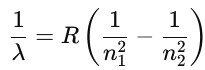
Where:
-
λ = wavelength of emitted or absorbed light (in meters)
-
= Rydberg constant
-
n1 = lower energy level
-
n2 = higher energy level
This deceptively simple expression allowed scientists to calculate, with remarkable accuracy, the wavelengths of light emitted when a hydrogen atom’s electron fell from one orbit to another. The visible “Balmer series” of hydrogen, those bright reds and blues familiar in classroom demonstrations, could now be predicted instead of merely observed.
Rydberg himself worked in relative obscurity for much of his career. His passion for uncovering order in spectral lines was not widely appreciated at first, since the deeper structure of the atom was still unknown. It was only later, when Niels Bohr developed his model of the hydrogen atom in 1913, that Rydberg’s work gained its true recognition. Bohr showed that electrons move in quantized orbits and that the energy differences between these orbits correspond exactly to the pattern Rydberg had discovered. In this way, the Rydberg constant became one of the cornerstones of quantum theory.
Even today, long after Rydberg’s lifetime, his constant remains one of the most precisely measured numbers in all of physics. It is used in atomic spectroscopy, astrophysics, and the study of fundamental constants. When scientists analyze the light from distant stars, they can use the Rydberg formula to identify hydrogen lines and learn about the composition and motion of celestial objects.
Johannes Rydberg may not be as famous as Bohr, Einstein, or Planck, but his contribution was indispensable. His constant is not just a number, rather, it is a bridge between observation and theory, a symbol of how patient mathematical curiosity can illuminate the hidden laws of nature.
